Why Manage Your Thoughts When You Can Go Beyond Them?
Not by quieting your thoughts, but by removing what keeps them pulling at you, so that a clear mind becomes your permanent state and you can perceive what lies beyond it.
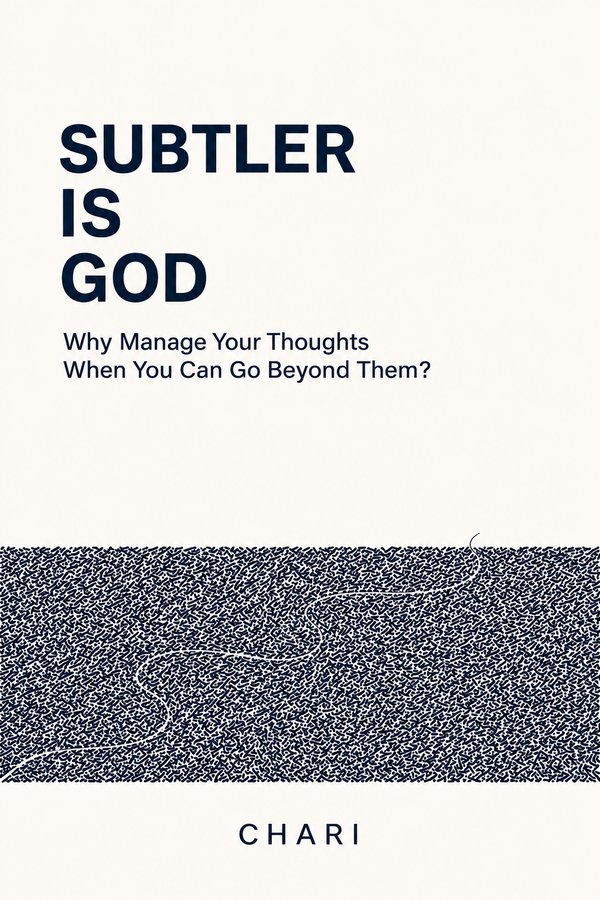
A book by Chari
The book
You sit quietly and the mind settles. Then comes a conversation, a deadline, a bad day, and it is gone. Meditation helps, but it works on how many thoughts you have, not on why they take you over.
So we accept it. We treat a crowded mind as simply how things are, and get by on escape hatches: a drink, overwork, the next achievement, a vacation. Yet as a society, we have never simply accepted the limits of nature. We have always learned how things work and reshaped them to suit the lives we want. Why should our attitude towards our own mind be any different?
Old hopes and fears, held in memory, keep pulling at your attention from beneath conscious thought. Resisting them is what turns that pull into the endless activity of thought.
Subtler Is God goes to the structure itself. See it clearly, and thought loses its grip, not just in the brief stretch after something that settles you, but in the middle of your day, all the time. Once that state is established, an awareness that thought no longer crowds or pulls, everything else becomes a choice, not something you need in order to feel at peace.
No belief required, and no practice to depend on. Every idea in this book is something you can test for yourself, starting today.
Inside
Disturbance doesn’t come from the number of thoughts you have. It comes from resisting them.
Much of the crowding we feel is attention waiting for a thought to fill it. There is nothing in thought to wait for.
And why the escape hatches we all rely on, from overwork to anger, are anything but harmless.
Action that runs on its own, a clear sense of direction, and a way of perceiving that doesn’t depend on the mind.
Principles of Attention
The book defines every term it uses, and ends each idea in a principle: a short reminder to come back to when thought pulls at you. Here are four of them.
Thought is separate from me; I feel it only if I reach for it.
Memories draw my awareness; it is my resistance that turns them into activity.
However important a thought seems, I will not let it pull my attention.
I will not use thought to feel good; it always comes at a price.
Read the opening
It began at school, when I was twelve. Someone said something to me, and I answered. It was a perfectly ordinary answer. But as I said it, I had a distinct and strange doubt. Whose thought was this? The response was fine. It just didn’t feel like mine. It didn’t match whatever idea I had of who I was.
Until that moment, every thought I had was mine, completely. If a thought came to me, it was a reflection of who I was and how I thought, and that was the end of it. I had never considered thought as something separate from me. Even the way we speak about it assumes there is no separation. If I felt angry, or happy, or sad, that was simply the truth. And if I wanted to feel differently, the only question was what I could change on the outside to get a different response, and so a different feeling. That was the paradigm everyone around me lived in, and I lived in it too.
So when I found myself disconnected from that one thought, everything else came loose. If this thought wasn’t mine, what about the others? I came home that day almost suspicious of my own mind, as though I had been letting impostors in without checking who they were. If I didn’t identify with a thought, it had to be coming from somewhere. Where? And if thought could come from somewhere, then perhaps there was a place from which I perceived it, separate from it. It was the first time that possibility had ever occurred to me.
The rhythm of those years was simple. You went to school, came home, and sat in your study room to do your homework and study for a set number of hours. I usually finished my work quickly, which left me time. And I wanted, more than anything, to figure this out.
Free chapter
Leave your email and you’ll get the opening chapters of Subtler Is God, short pieces on the principles as they’re written, and word of the book’s release.
No spam. Unsubscribe at any time.